




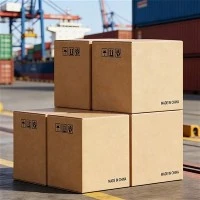

Corrugated Shipping Cartons
Heavy-duty corrugated shipping cartons are used for transporting industrial parts, machinery components, automotive parts, consumer products, and other goods that require greater compression and handling resistance than standard cartons. For B2B buyers, the main selection factors are product weight, box dimensions, board construction, stacking conditions, transport method, internal protection, and pallet configuration.
Standard RSC constructions can be used for general shipping, while custom die-cut or reinforced structures can be specified when the product requires particular openings, inserts, closures, or load distribution.
Quick Specification Guide
|
Selection Factor |
Available / Reference Options |
|
Box Style |
RSC, custom die-cut and project-specific constructions |
|
Board Structure |
Single-wall or double-wall corrugated board |
|
Flute Options |
B-flute, C-flute, BC double-wall and other project-specific combinations |
|
Board Grades in Original Specification |
ECT 32, 44, 48 and 55 |
|
Joint Construction |
Glued or stitched, according to specification |
|
Customization |
Dimensions, structure, printing, inserts, partitions and closures |
Board Structure and Strength Selection
The board grade should be selected according to the packaged product, stacking load, handling conditions, and transportation environment.
|
Construction |
Typical Selection Consideration |
|
B-Flute |
Relatively compact corrugated construction with a good balance of thickness, crush resistance, and printability |
|
C-Flute |
Greater thickness and cushioning for general shipping applications |
|
BC Double-Wall |
Higher structural thickness for heavier products and demanding stacking conditions |
|
Single-Wall |
Suitable for products where one corrugated layer provides sufficient protection and compression resistance |
|
Double-Wall |
Suitable when additional rigidity, stacking strength, or puncture resistance is required |
The original specification identifies ECT 32, ECT 44, ECT 48, and ECT 55 board grades. These values should be treated as board specifications rather than direct payload ratings, because the load capacity of a completed carton also depends on dimensions, box style, product geometry, stacking height, closure, and distribution conditions.
Key Shipping Carton Specifications
The supplied product specification includes the following dimensional and construction ranges:
|
Specification |
Reference Range / Option |
|
Length |
100–1200 mm |
|
Width |
80–800 mm |
|
Height |
50–1000 mm |
|
Board Grade |
Single-wall ECT 32 / 44; double-wall ECT 48 / 55 |
|
Joint |
Water-based adhesive gluing or steel-wire stitching |
|
Box Style |
RSC and custom die-cut structures |
Actual board construction, dimensions, tolerances, and joint method should be confirmed against the approved carton drawing and order specification.
Product Dimensions and Box Design
Custom carton dimensions should be based on the packaged product rather than selecting an oversized standard box. The internal length, width, and height should allow the required protection while limiting unnecessary void space.
For heavy or irregular products, the design should also consider:
• Product center of gravity
• Concentrated loads
• Sharp edges and corners
• Required internal clearance
• Stacking orientation
• Pallet footprint
• Forklift or pallet-jack handling
• Closure and opening method
RSC cartons are suitable for many general shipping applications. Custom die-cut structures can be considered when the carton requires special openings, handles, partitions, locking features, or product-specific geometry.
Internal Protection
The outer carton is only one part of the packaging system. Products that can move inside the carton may require additional internal protection.
Possible options include:
• Corrugated pads
• Die-cut inserts
• Dividers and partitions
• Corner protection
• Base reinforcement
• Honeycomb paperboard
• Molded fiber components
• Other project-specific cushioning materials
For dense metal components, the internal structure should distribute concentrated loads and prevent sharp edges from directly contacting the carton walls.
Applications
Heavy-duty corrugated shipping cartons can be specified for a range of B2B distribution requirements, including:
E-commerce fulfillment: Consumer products, electronics, apparel, cosmetics, and other shipped goods
Industrial parts: Fasteners, valves, fittings, hardware, and mechanical components
Automotive parts: Dense metal or machined components requiring additional carton strength
Machinery components: Pumps, motors, gearboxes, and other mechanical assemblies
Dry-goods packaging: Secondary packaging for products transported through conventional distribution networks
For refrigerated or high-humidity logistics, the board and any moisture-protection treatment should be selected according to the actual temperature, condensation, storage, and transport conditions.
Printing and Customization
Shipping cartons can use printing for product identification, handling instructions, barcodes, shipping marks, and brand graphics.
Flexographic Printing
Direct printing on corrugated board is suitable for text, symbols, barcodes, handling marks, and standard multi-color graphics. The number of colors and print area should be confirmed with the artwork and board specification.
Custom Structural Styles
The original specification identifies FEFCO-style constructions including 0201, 0427, and 0301. The appropriate style depends on the product dimensions, opening method, closure requirements, and packing process.
Other structural options may include:
• Custom die-cut openings
• Hand holes
• Locking tabs
• Special closures
• Internal partitions
• Reinforced bottom structures
• Ventilation openings where required
Moisture and Export Considerations
Corrugated board performance can be affected by prolonged exposure to high humidity, condensation, and direct water. For long-distance or maritime transportation, moisture protection should therefore be evaluated according to the actual shipping environment.
Possible measures include moisture-resistant board constructions, coatings, liners, or external protective packaging where appropriate. These should be specified according to the required storage and transit conditions rather than applied universally.
For palletized export shipments, buyers should also consider:
• Pallet footprint
• Box orientation
• Maximum stacking height
• Overhang or underhang
• Total pallet weight
• Container loading
• Handling equipment
• Transit duration
• Storage conditions
If wooden pallets are used for international shipments, the applicable import requirements for the destination country should be confirmed separately.
Quality and Inspection
Quality checks should be based on the approved carton specification and applicable test requirements. Depending on the project, relevant inspections may include:
• Board grade and flute construction
• Board thickness and grammage
• Carton length, width, and height
• Die-cut and crease accuracy
• Joint integrity
• Printing position and artwork conformity
• ECT testing where specified
• Burst strength testing where specified
• Cobb water absorption testing where moisture resistance is specified
• Compression or distribution testing where required
ECT evaluates the edgewise compression resistance of corrugated board, while burst testing evaluates resistance to rupture. These board-level measurements should not be treated as direct substitutes for testing the completed carton under its actual loading and distribution conditions.
Packaging and Delivery
Cartons are normally supplied flat when the structure permits this configuration, allowing the buyer to store and erect the boxes as required. Bundling, palletization, strapping, and external protection should be specified according to the carton size, shipping method, and warehouse handling requirements.
For international orders, the buyer should provide the destination and preferred pallet or packing requirements when these affect the shipping configuration.
What Buyers Should Provide
For accurate structural selection and quotation, provide:
Product dimensions: Length × width × height
Product weight: Unit weight and total weight per carton
Product characteristics: Fragile areas, sharp edges, concentrated loads, or irregular geometry
Required carton style: RSC or project-specific structure
Stacking requirements: Warehouse stacking height and expected load
Transport method: Truck, sea freight, air freight, or multimodal transport
Pallet requirements: Pallet dimensions and handling method
Internal protection: Inserts, dividers, cushioning, or reinforcement
Printing requirements: Plain, handling marks, barcodes, or custom graphics
Order quantity and delivery destination
An existing carton sample, dieline, CAD drawing, product photograph, or pallet-loading diagram can help determine the appropriate carton construction.
Frequently Asked Questions
Q: What is the difference between single-wall and double-wall shipping cartons?
A: Single-wall cartons use one corrugated layer and are suitable where the required compression and protection can be achieved with that construction. Double-wall cartons combine two corrugated layers and are generally considered when greater rigidity, stacking resistance, or puncture resistance is required.
Q: Does ECT determine the maximum weight a carton can carry?
A: No. ECT is a board compression measurement, not a universal carton payload rating. The completed carton's performance also depends on box dimensions, construction, closure, product geometry, stacking conditions, and transport environment.
Q: Can heavy-duty cartons be customized for irregular products?
A: Yes. Custom dimensions, die-cut structures, inserts, partitions, pads, and reinforcement can be specified according to the product geometry and loading requirements.
Q: Can these cartons be used for export shipping?
A: Yes, corrugated shipping cartons can be specified for international transportation. However, board construction, moisture protection, palletization, stacking, and handling requirements should be evaluated according to the actual export route and storage conditions.
Q: What information is needed for a custom shipping carton quotation?
A: The key information includes product dimensions, unit weight, quantity per carton, carton style, stacking conditions, transport method, pallet requirements, internal protection, printing requirements, order quantity, and delivery destination.
Request a Shipping Carton Quote
Provide the product dimensions, unit weight, quantity per carton, required carton style, stacking conditions, transport method, pallet requirements, and printing needs. A product sample, photograph, existing dieline, CAD drawing, or packaging specification can also help define the carton structure and quotation.
Hot Tags: corrugated shipping cartons, China corrugated shipping cartons manufacturers, suppliers, factory
Previous
Export Shipping CartonsNext
No InformationYou Might Also Like




Send Inquiry